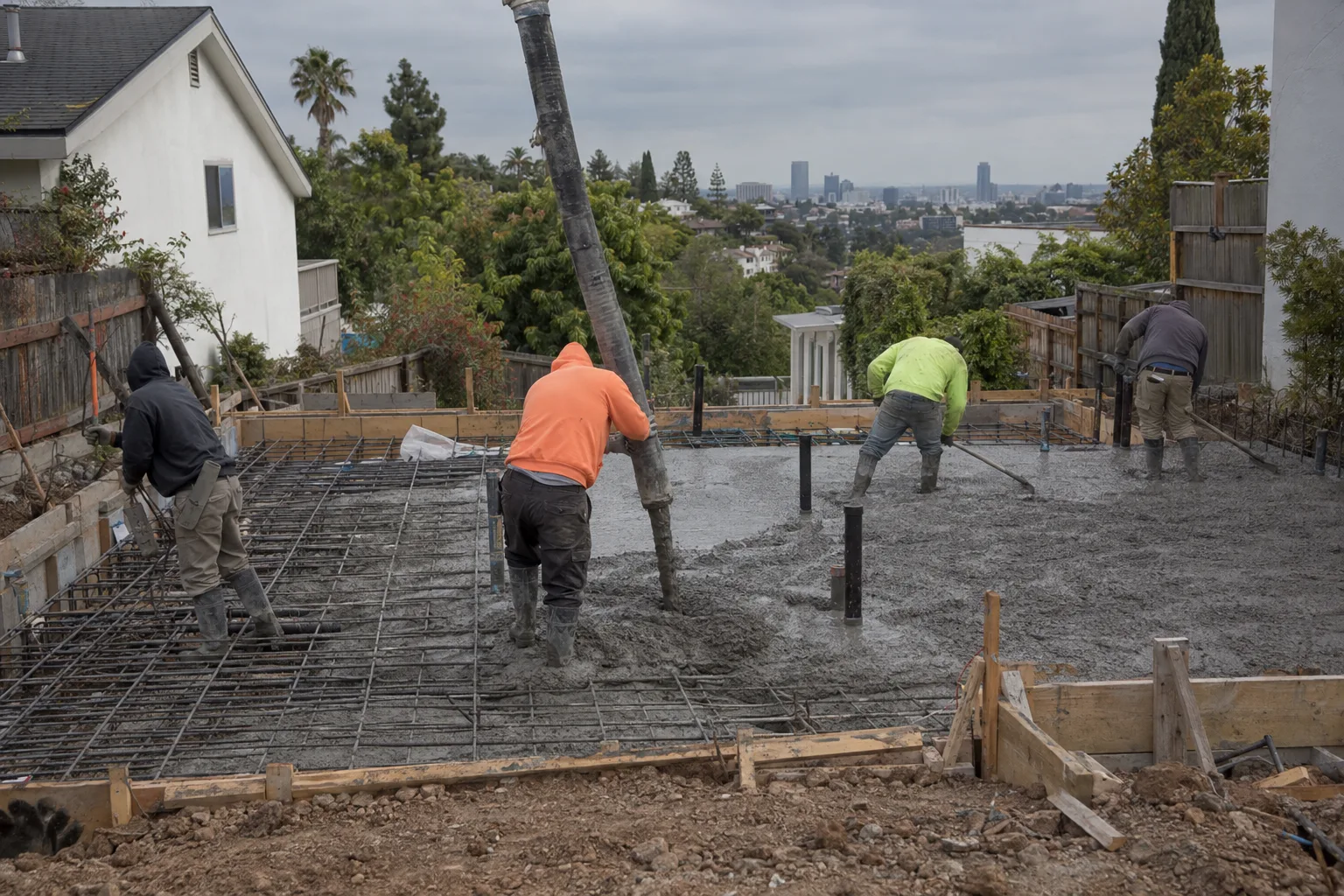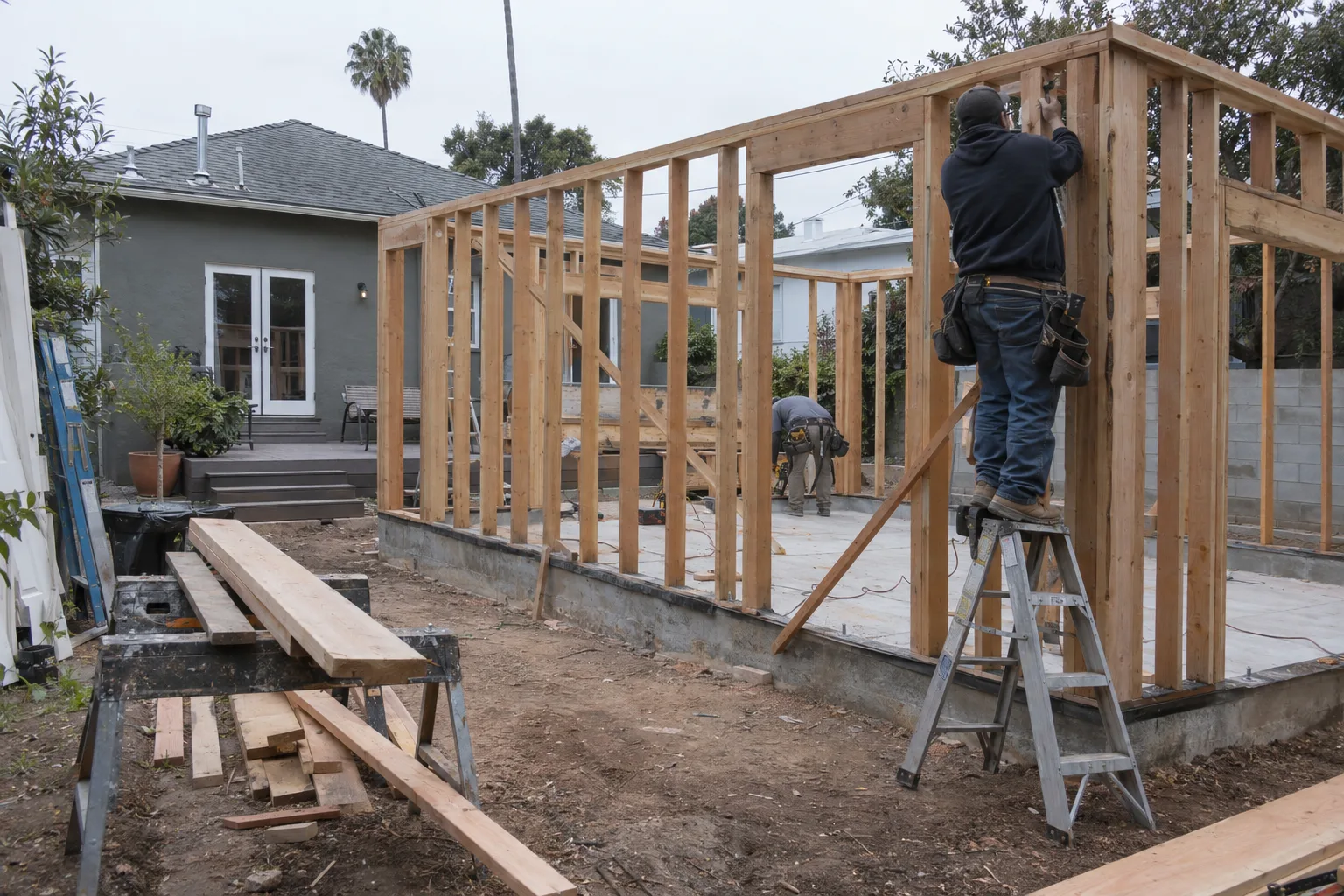
One crew handles clearing, grading, and excavation - then stays on for the full build.
What Site Preparation Actually Covers - and Why Sequence Matters
Site preparation is the full process of making raw land ready to build on safely.
Sequence is what makes site preparation work. The clearing sets up the grade. The grade sets up drainage. The drainage path protects the foundation from pooling water after every Los Angeles rain event. Separate crews between phases and errors compound quietly - until something above grade shows them.
How Los Angeles Soil and Slope Shape Every Excavation Decision
Los Angeles is not one soil type. It's dozens, sometimes within a single lot.
Our crew works out of 1433 N Martel Ave - a short drive from Silver Lake ridgelines, the graded flatlands near Culver City, and the canyon-edge parcels in Hollywood Hills. Those neighborhoods each carry different excavation conditions.
Expansive clay soil - a type that swells when wet and contracts when dry - is common on LA's flatter parcels. It shifts seasonally, creating movement risk if a foundation is placed without proper soil amendment or over-excavation. On hillside lots, decomposed granite is the frequent challenge. Decomposed granite is weathered rock that's granular and unstable when disturbed. It looks firm until a load is placed on it without recompaction.
Here's what matters about Los Angeles grading: drainage gradient - the directional slope built into a site to move water away from the structure - is often constrained by adjacent hardscape, neighbor property lines, or an existing retaining wall. Knowing those constraints before the first cut is how you avoid regrading twice.
A Call We Often Get: The Pad Is Off and the Foundation Hasn't Been Poured Yet
The most recoverable site problems are the ones caught before concrete goes down.
I'm Liam Harris, founder of SNA Remodeling Hollywood. A situation we run into regularly goes something like this: a property owner brings us in for foundation work after site prep was handled separately. When we check the grade, the elevation is off - sometimes by two or three inches, sometimes more.
That variance sounds small. But an off-grade pad changes the foundation form height, affects finish floor elevation, and can put the slab below the drainage gradient instead of above it. In Los Angeles, where winter rain events are infrequent but intense, a slab that sits even slightly low in its drainage plane will collect water.
The fix at that point isn't complicated, but it takes time. We re-establish the grade, confirm the drainage slope runs correctly away from the structure, and check soil compaction before we proceed. It's work that didn't need to happen if the prep and foundation phases were connected from the start.
That's why our crew handles both. The same people setting the excavation depth understand what the foundation phase requires. Grade elevations and cut-and-fill calculations - the earthwork method of removing soil from high points and using it to build up low points - are done to the specs of the complete project.
When the Grade and Drainage Are Correct, Every Phase That Follows Is Simpler
A properly graded site makes foundation work, framing, and utilities straightforward.
Property owners sometimes ask what happens if soil conditions turn out to be more complex than expected. We assess the site before finalizing the excavation plan. That assessment includes checking soil type, looking at natural drainage paths, and confirming where adjacent structures or boundaries will affect grading options.
Los Angeles County and local city departments have specific grading permit requirements for earthwork above a certain volume. We factor permit requirements into the project sequence so grading work proceeds without stops for documentation that should have been in place on day one.
How We Establish a Site From First Clear to Final Grade
Every site prep engagement follows the same standard - regardless of lot size or complexity.
What our process covers:
- Land clearing and vegetation removaldown to the build envelope, including root mass where root intrusion would affect bearing capacity
- Cut-and-fill earthworkcalculated to the project's pad elevation requirements - not an approximation
- Drainage gradient establishmentwith a minimum 2% slope away from the planned foundation perimeter (the standard required by most LA-area jurisdictions)
- Soil compactionto confirm bearing capacity before foundation crews proceed
- Excavation depthset to reach stable bearing material, verified against the foundation type specified for the project
- Site boundary awarenessgrading decisions account for setbacks, retaining walls, and adjacent property drainage so work doesn't redirect water toward a neighboring structure
The Specific Steps We Take Before We Hand the Site to the Foundation Crew
Site handoff is a checkpoint, not just a transition.
Site Walk and Conditions Assessment
We start with a site walk. Soil type, natural drainage direction, existing grade elevation, and nearby structures are all documented before equipment arrives. For hillside lots in neighborhoods like Silver Lake or Pasadena, we note decomposed granite layers and plan recompaction accordingly.
Clearing, Earthwork, and Excavation
Land clearing comes first. Vegetation, debris, and loose surface material are removed to the limits of the build area. Cut-and-fill earthwork follows, using material from high points to build up low areas. Excavation is then taken to the specified depth for the foundation type - pier-and-beam depths differ from slab-on-grade depths, and both differ from basement excavation requirements.
Drainage gradient is set and verified with a level before compaction begins. Soil compaction follows in lifts - layers compacted one at a time, not all at once - to achieve uniform density through the full depth of fill.
Grade Verification Before Handoff
Before we release the site to the foundation phase, we walk the grade with a level at multiple points. Drainage slope is confirmed. Excavation depth is spot-checked at corners and center. Compacted areas are visually checked for uniformity. Anything that's off gets corrected before concrete is ordered.
Greater Los Angeles Sites We Prepare and Excavate
We prepare sites across the full Los Angeles metro area and beyond.
Our crews work throughout Los Angeles, West Hollywood, Hollywood, Silver Lake, Beverly Hills, Culver City, Burbank, Glendale, Santa Monica, Studio City, Sherman Oaks, Pasadena, Encino, and across the San Fernando Valley. We also serve Long Beach, Torrance, Inglewood, and communities east toward the San Gabriel Valley and Inland Empire. If your lot is in the Greater LA area, we can assess it.
Your Site Assessment Starts With a Conversation
The right excavation plan begins with knowing what your specific lot requires.
Call us at +1 323-761-0179 or email info@snaremodeling.com to describe your project and location. We'll talk through soil conditions, grade requirements, and the sequence that fits your build. Every site preparation and excavation project we take starts with understanding the lot - not with a standard quote for a lot we haven't seen.