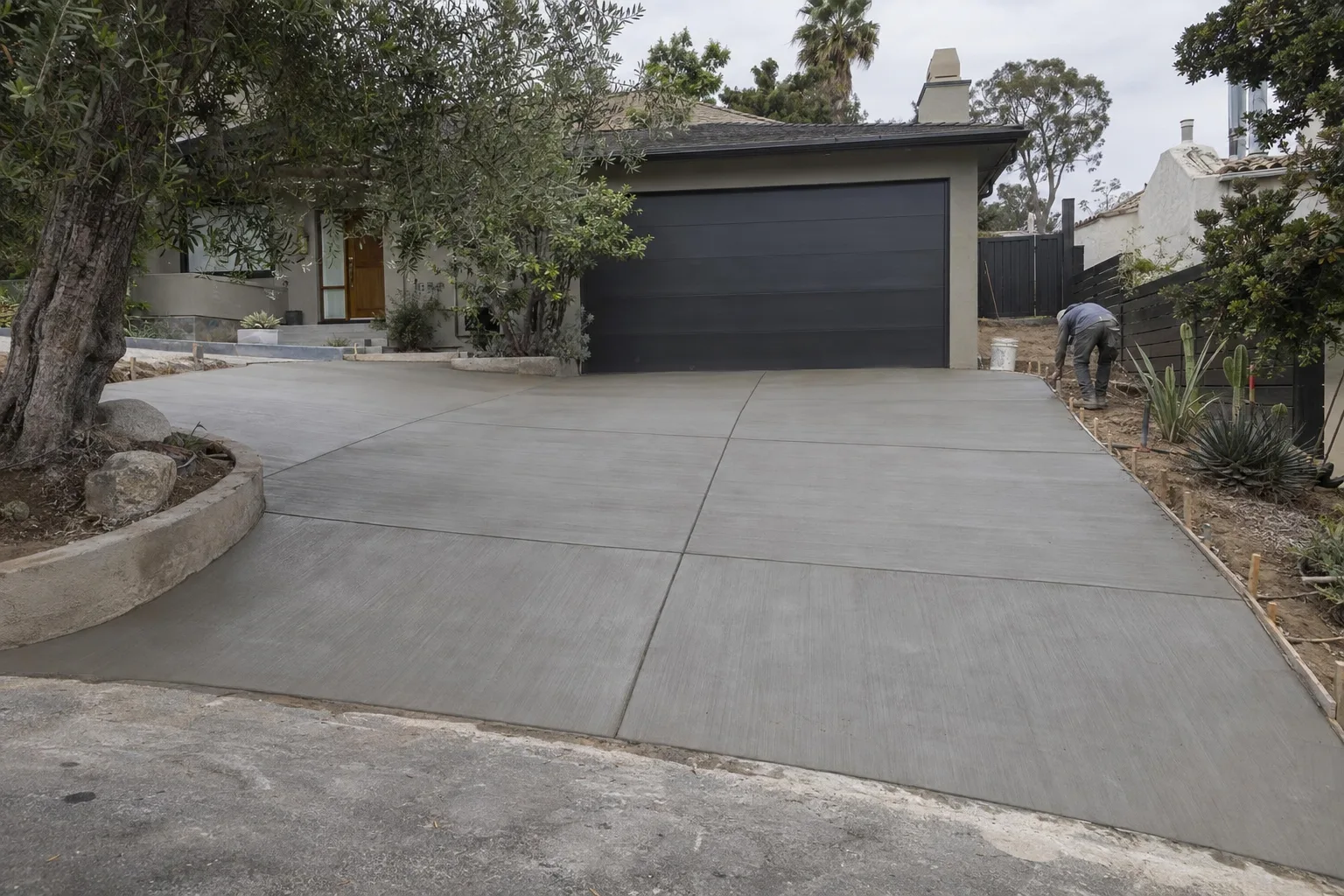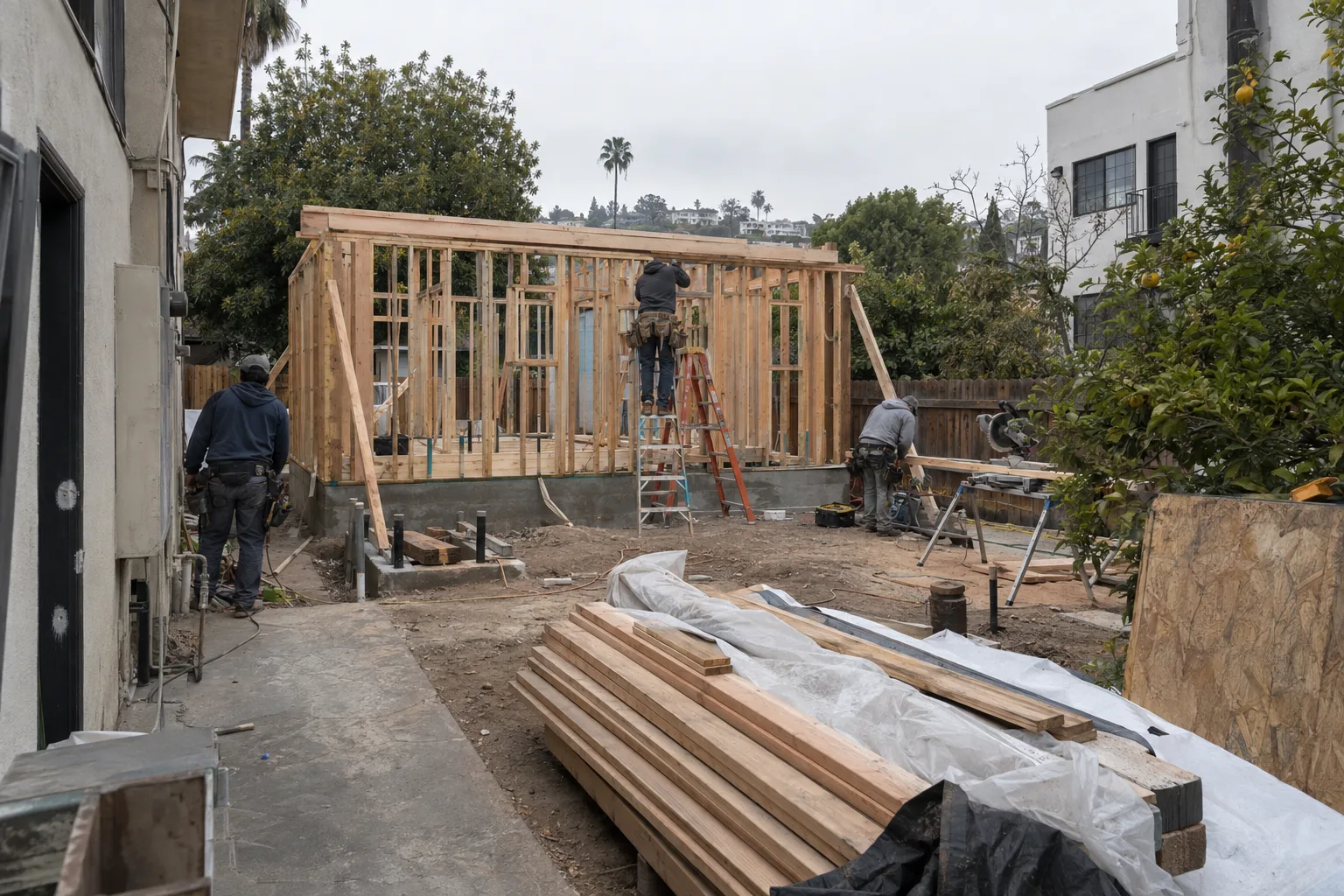
What Goes Into a Concrete Driveway That Actually Holds Up
A concrete driveway lasts when the ground beneath it is built right first.
The visible surface gets all the attention. But what's underneath decides everything. Subgrade preparation - the grading and compaction of the soil below the slab - is where a driveway either holds together or starts to shift.
The concrete slab itself is the poured and cured structural surface you drive on. It can't perform unless the base is stable. Los Angeles soil varies block to block. Some areas have heavy clay that holds water. Others have sandy fill that compresses unevenly under vehicle load - the weight and frequency of cars, trucks, and SUVs that press down on the slab every day.
Skip the base work, and you're pouring money into a surface that will crack within a few years. Do it right, and a properly installed concrete driveway in Los Angeles will hold up for decades.
Control joints matter too. These are planned cuts in the slab that guide where cracking occurs and prevent random fracturing across the surface. A slab without them is guessing where it will break. One with them isn't.
Driveways Across Los Angeles Take a Different Kind of Beating
Los Angeles driveways face thermal expansion stress that most homeowners never think about.
Thermal expansion - the way concrete expands when it heats up and contracts when it cools - is a real force in Southern California. Summer pavement temperatures in Los Angeles regularly hit 150°F or higher. January nights cool things down fast. That cycle repeats hundreds of times over the life of a driveway.
The clay-heavy lots in neighborhoods like Silver Lake and Culver City can shift several inches vertically over a wet-dry cycle. That's not a small movement. A slab sitting on top of that soil without proper compaction and forming and framing - the temporary borders that shape the pour - will follow that movement. Usually in the wrong direction.
The 90046 zip code includes properties with steep grades, narrow lots, and tight approaches. West Hollywood has decades-old slabs poured before modern concrete driveway standards existed. Replacement work here almost always starts with more excavation than the homeowner expected.
A Call We Often Get: "The Surface Cracked After Two Winters"
The surface cracking isn't usually the problem - it's the symptom.
I'm Liam Harris, founder of SNA Remodeling Hollywood. A common call we get goes something like this: a homeowner replaced their driveway two or three years ago, and it's already cracking along the edges and through the center. They want to know why.
Nine times out of ten, the answer is subgrade preparation - or the lack of it. The previous crew poured a new concrete slab directly over poorly compacted soil. Or they skipped the control joints. Or they formed the slab without accounting for the grade and drainage of that specific lot.
Los Angeles properties in neighborhoods like Sherman Oaks or Studio City often sit on soil graded decades ago for older, lighter vehicles. Modern SUVs and trucks put a heavier vehicle load on a slab than a 1970s sedan ever did. The old assumptions about slab thickness don't hold.
When we assess a concrete driveway project, we start at the grade, not the surface. We check drainage direction, soil type, and compaction depth before we talk about finish options. A broom finish, exposed aggregate, or a smooth surface finish - the texture applied while concrete is still workable - means nothing if the foundation underneath isn't set up for the load it's about to carry.
That's why our scope starts below grade and moves up. Every step in sequence.
Every Stage Is Handled by the Same Crew
Your concrete driveway project stays with one team from site assessment through final finish.
One crew. Every step. That's not a selling point - it's a quality control mechanism.
When the same people who prepared the subgrade also set the forms and pour the concrete, there's no miscommunication between stages. The person finishing the surface knows exactly what's underneath it. If something changes during the pour - weather shifts, a soft spot shows up in the base - the team makes the call on the spot.
SNA Remodeling Hollywood operates with a 10-person crew out of our Los Angeles office. We handle concrete driveway installation alongside broader hardscape and site work - including site preparation and excavation and hardscape design and installation. It's all connected. And it stays in-house.
How We Prepare, Form, Pour, and Finish Your Driveway
Every concrete driveway we install follows the same quality sequence - no steps skipped.
Our process on every new concrete driveway installation in Los Angeles:
- Subgrade gradingto correct slope, drainage direction, and depth before any material goes down
- Compactionof the base layer to the density required for the vehicle load that driveway will carry
- Forming and framingset to the exact dimensions and grade of the property - adjusted for narrow lots and steep approaches where needed
- Reinforcementpositioned correctly within the form before the pour begins
- Control joint placementplanned and executed to guide stress cracking away from high-traffic zones
- Surface finishapplied at the right stage - broom, exposed aggregate, or smooth - based on use and client preference
- Curingmanaged to protect the slab from Los Angeles heat during the critical first days
For related hardscape projects, we also install concrete walkways, pavers, and handle concrete installation and construction as part of a unified exterior scope.
The Steps Between Your Call and a Finished Slab
Concrete driveway installation in Los Angeles follows a clear sequence - here's what that looks like.
Site Assessment
We start with the property itself. Grade, drainage, existing surface condition, and soil type all get checked before we confirm scope. For a residential concrete driveway in Los Angeles, we look at approach width, any existing curb cuts, and how the lot drains during rain. Properties in hillside neighborhoods require additional review for slope and retaining needs.
Implementation
Forming and framing goes in first. Then compaction is verified. The pour is scheduled based on weather - we don't pour in extreme heat without a curing plan in place. Concrete is placed, struck off, and finished to the specified texture. Control joints are cut at the correct intervals before the surface sets.
Post-Pour Review
After curing, we walk the finished slab. We check joint placement, edge condition, and surface texture uniformity. Any area that doesn't meet our standard gets addressed before the project closes. The goal: a new concrete driveway that still looks correct five years from now, not just five days after the pour.
Concrete Driveway Installation Across Greater Los Angeles
SNA Remodeling Hollywood serves the full Los Angeles basin for concrete driveway work.
We install residential and commercial concrete driveways across Los Angeles, West Hollywood, Hollywood, Silver Lake, Culver City, Beverly Hills, Burbank, Glendale, Santa Monica, Studio City, Sherman Oaks, Van Nuys, Pasadena, Encino, Torrance, Long Beach, and dozens of communities throughout the Greater Los Angeles area and San Fernando Valley. Our office is at 1433 N Martel Ave, Los Angeles, CA 90046.
Ready to Replace That Driveway? Here's How to Start
The first step is a site look - not a sales call.
Call SNA Remodeling Hollywood at (323) 761-0179 or email info@snaremodeling.com. Tell us the address, the approximate driveway size, and whether it's a full replacement or a new pour. We'll take it from there. One crew, every step, from the subgrade up.