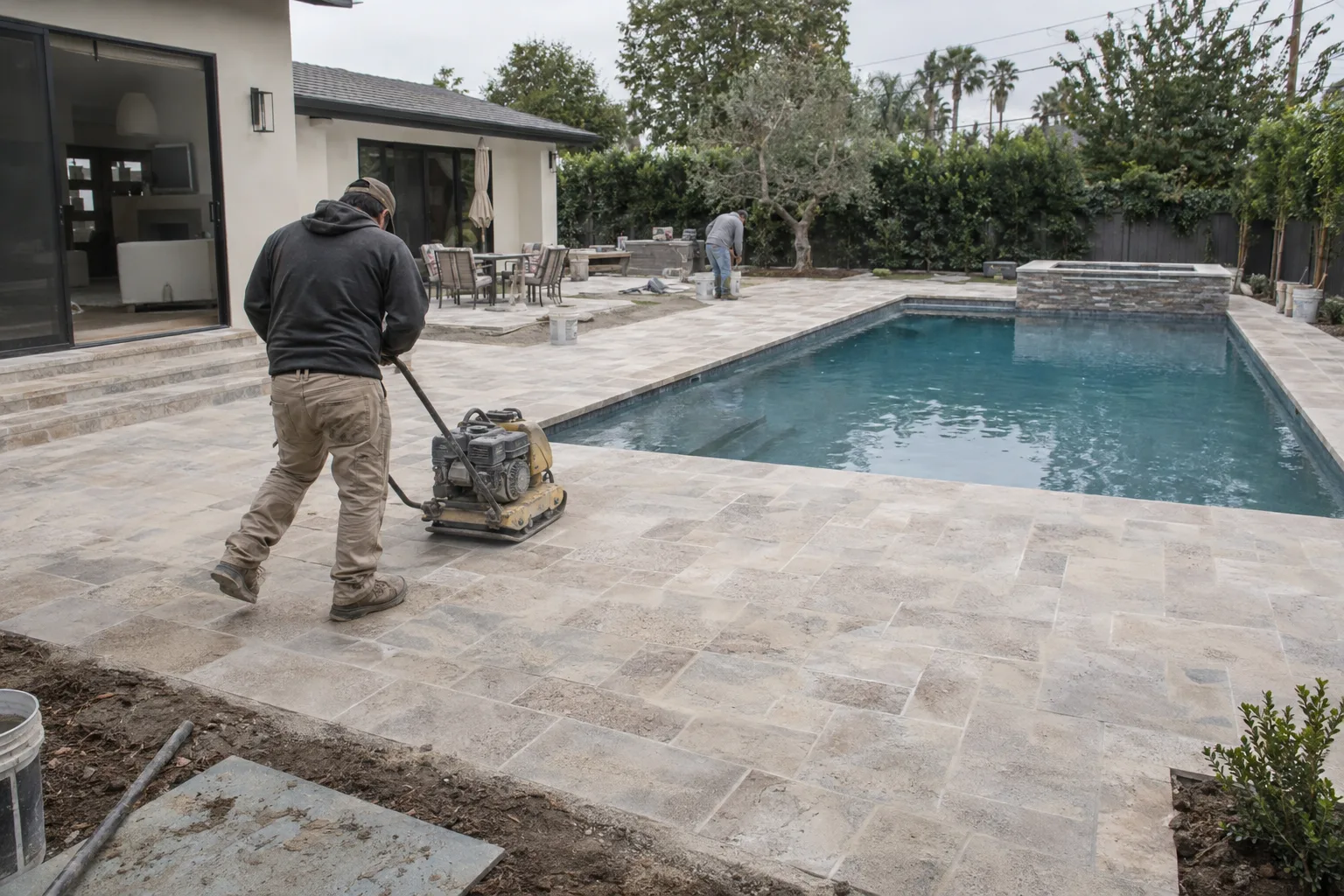
Every base graded, compacted, and set by the same crew - start to finish.
What Pavers Installation Covers and What It Takes to Do It Right
Pavers installation is a structured process - not just laying stones on the ground.
A setting bed is the bedding layer - typically coarse sand or decomposed granite - on which pavers rest and are leveled before they're locked in. It sounds simple. Done without care, it's the first place a surface fails.
Pavers installation covers driveways, patios, walkways, pool surrounds, and outdoor living areas. Materials range from interlocking concrete pavers (ICP) - manufactured units designed to distribute load across neighboring pavers, used on driveways and high-traffic surfaces - to natural stone pavers like travertine, flagstone, or slate, which are cut or shaped and used where texture, heat tolerance, and street-visible aesthetics matter most.
Your finished surface is visible from the street. It's underfoot every day. Getting there means doing the subsurface work correctly first.
SNA Remodeling Hollywood handles pavers installation from excavation through final compaction - one crew, one process, one job site.
Why Los Angeles Yards Demand a Smarter Paving Approach
Los Angeles soil moves. A rigid poured surface doesn't move with it.
Much of the residential soil across Los Angeles - from Silver Lake to Sherman Oaks to Culver City - is expansive clay. Clay swells when it absorbs moisture and contracts as it dries out. That seasonal cycling puts steady pressure on any surface sitting above it. Concrete slabs respond to that pressure by cracking. Wide asphalt areas develop ruts and low spots.
Pavers respond differently. Because each unit is individual, minor ground movement shifts a paver slightly rather than fracturing a slab across its full width. One sunken or cracked piece can be lifted, the base corrected underneath, and the paver reset - without touching the rest of the surface.
Here's what many Los Angeles homeowners discover when they start planning a paved surface: the city's stormwater requirements increasingly favor permeable or semi-permeable surfaces in residential yards. Properly jointed pavers with a well-graded drainage slope - the engineered grade built into the base to direct water away from structures - can reduce pooling near foundations without requiring a separate drain system.
West Hollywood and Beverly Hills yards, in particular, often have small footprints with significant hardscape coverage. Getting the drainage slope right matters on every project, regardless of size.
A Call We Often Get: "My Pavers Shifted - Can They Be Fixed Without Starting Over?"
A shifted paver surface usually points to base failure, not paver failure.
I'm Liam Harris, founder of SNA Remodeling Hollywood. One situation we run into often in Los Angeles goes like this: a homeowner has a paver patio or driveway that's a few years old. A few pavers have sunk. A few others have lifted. There's a lip between sections that wasn't there before. The pavers themselves look fine. The surface looks like a problem.
What they're describing is almost never a paver problem. It's a base problem.
When the sub-base under a paver surface isn't compacted uniformly - or when the excavation depth wasn't matched to the load the surface would carry - the ground settles unevenly beneath the setting bed. The pavers above follow whatever the ground below does. Individual units tilt. Joints open up. Water gets in and accelerates the movement.
What we look at first is whether edge restraints - the perimeter border installed to prevent individual pavers from spreading or shifting outward - were installed correctly to begin with. An edge restraint that wasn't pinned at proper intervals lets the field pavers drift laterally over time, especially on a driveway with vehicle weight pushing across the surface regularly.
The good news: an individual section can often be corrected. Pavers are lifted, the base is re-excavated, recompacted, and re-graded. The setting bed is reset. Pavers go back down. Polymeric jointing sand - sand mixed with binders that hardens in the joints and resists weed growth and insect entry - is swept back in and compacted.
That's a repair that works because the units are individual. It's the core advantage of a paver surface over a continuous slab in an LA yard that shifts through the seasons.
How a Well-Installed Paver Surface Performs Year After Year
A properly built paver surface handles heat, traffic, and seasonal soil movement without showing it.
Los Angeles summers push surface temperatures well above the air temperature. Natural stone pavers - particularly travertine - stay cooler underfoot than darker paved surfaces because their lighter color and porous surface don't absorb heat the same way. Pool surrounds in this climate especially benefit from that material choice.
On the structural side, interlocking concrete pavers distribute vehicle weight across a larger area by transferring load through the joints to adjacent units. A single paver doesn't carry the load alone - its neighbors do, too. That's what "interlocking" means in practice.
A question we hear regularly: how much maintenance does a paver surface actually need? Honest answer - less than most homeowners expect, as long as the install was done right. Polymeric jointing sand limits weed growth in the joints. Edge restraints keep the perimeter tight. Beyond periodic rinsing and occasional resealing of natural stone surfaces, a well-installed paver surface holds its appearance without intervention.
That performance starts at the base. It's not visible once the job is done. But it's what you're standing on.
From Excavation to Edge Restraint: How We Install Every Surface
Every phase of pavers installation follows a fixed sequence - no steps skipped, no order reversed.
Our process at SNA Remodeling Hollywood is consistent across every pavers job in Los Angeles:
- Excavation depth matched to use.A pedestrian walkway and a vehicle driveway require different excavation depths and different base thicknesses. We set that before anything goes in the ground.
- Sub-base compacted in lifts.Compaction happens in layers, not all at once. Each lift is compacted before the next layer is added. This produces uniform density through the entire base column.
- Drainage slope built into the grade.Every surface is graded to direct water away from the structure at a minimum 1-2% slope, depending on the yard layout.
- Edge restraints installed before field pavers.The border goes down first. Always. Field pavers are then set inside a contained perimeter - not the other way around.
- Setting bed leveled and screeded.The coarse sand or gravel bed is screeded to a consistent depth before any paver is placed.
- Pavers laid to pattern.Running bond, herringbone, basket weave, or fan - pattern is confirmed before the first unit goes down.
- Polymeric jointing sand swept and compacted.Final compaction locks the joints. The plate compactor passes over the entire surface to seat every unit fully into the setting bed.
Natural stone surfaces receive sealer as part of the finish - applied after compaction, not as an afterthought.
Set the Bed Right, and the Pattern Takes Care of Itself
The setting bed is where precision lives on every pavers installation project.
Site Assessment
Before any material moves on a pavers installation project in Los Angeles, we assess the site conditions first. That means checking the existing grade, identifying any low spots where water pools, noting proximity to foundation walls or drainage structures, and confirming soil type. LA's clay-heavy soils in neighborhoods like Silver Lake and Culver City require a more aggressive sub-base compaction approach than sandy coastal soils closer to Santa Monica.
Existing surfaces - old concrete, crumbling asphalt, overgrown ground cover - are evaluated for whether they come out completely or get incorporated as part of the base. Most driveways and patios in older Los Angeles neighborhoods need full removal before the new base goes in.
Installation
Excavation depth is determined by surface use. Pedestrian areas typically need 4-6 inches of compacted base. Vehicle driveways need 6-8 inches, sometimes more when soil conditions require additional depth. The base material - crushed aggregate - is added in compacted lifts of no more than 3-4 inches at a time.
Once the base is established, edge restraints are staked into position along the full perimeter. Then the setting bed - 1 inch of coarse sand or decomposed granite - is screeded flat and level across the entire area. Pavers are laid from a corner or a straight edge, following the agreed pattern. Cuts happen at the edges, not in the field.
Pavers are never forced into position. If a unit doesn't sit flat, the setting bed underneath it is adjusted - not the paver above it.
Final Walk and Sign-Off
After the final compaction pass, we walk the surface systematically. Every paver gets checked for rocking or hollow sound - a hollow tone under foot pressure indicates a void in the setting bed below. Any unit that doesn't pass gets lifted, the bed corrected, and the paver reset before the job is signed off.
Joints are filled, compacted, and misted to activate the polymeric binders. The surface is left clean, swept, and ready to use.
Paver Installation Across Greater Los Angeles
SNA Remodeling Hollywood installs pavers throughout the Greater Los Angeles area.
Our crews work across Los Angeles, West Hollywood, Silver Lake, Culver City, Beverly Hills, Studio City, Sherman Oaks, Santa Monica, and the San Fernando Valley. We're based at 1433 N Martel Ave in Los Angeles - close to Melrose Avenue - and reach neighborhoods on both the Eastside and Westside regularly. If you're in the broader LA basin, we serve your area.
Explore our work in Beverly Hills, Santa Monica, Burbank, Pasadena, and Long Beach.
Ready to See What Your Driveway or Patio Could Look Like?
The right paver surface starts with a conversation about your site, your goals, and your grade.
Tell us what you're working with - driveway, patio, walkway, pool deck, or a combination. We'll assess the site, talk through material options, and give you a clear picture of the process. Call SNA Remodeling Hollywood at +1 323-761-0179 or email info@snaremodeling.com to get started. You can also explore our hardscape design and installation and concrete pavers pages to see what pairs well with a pavers project.