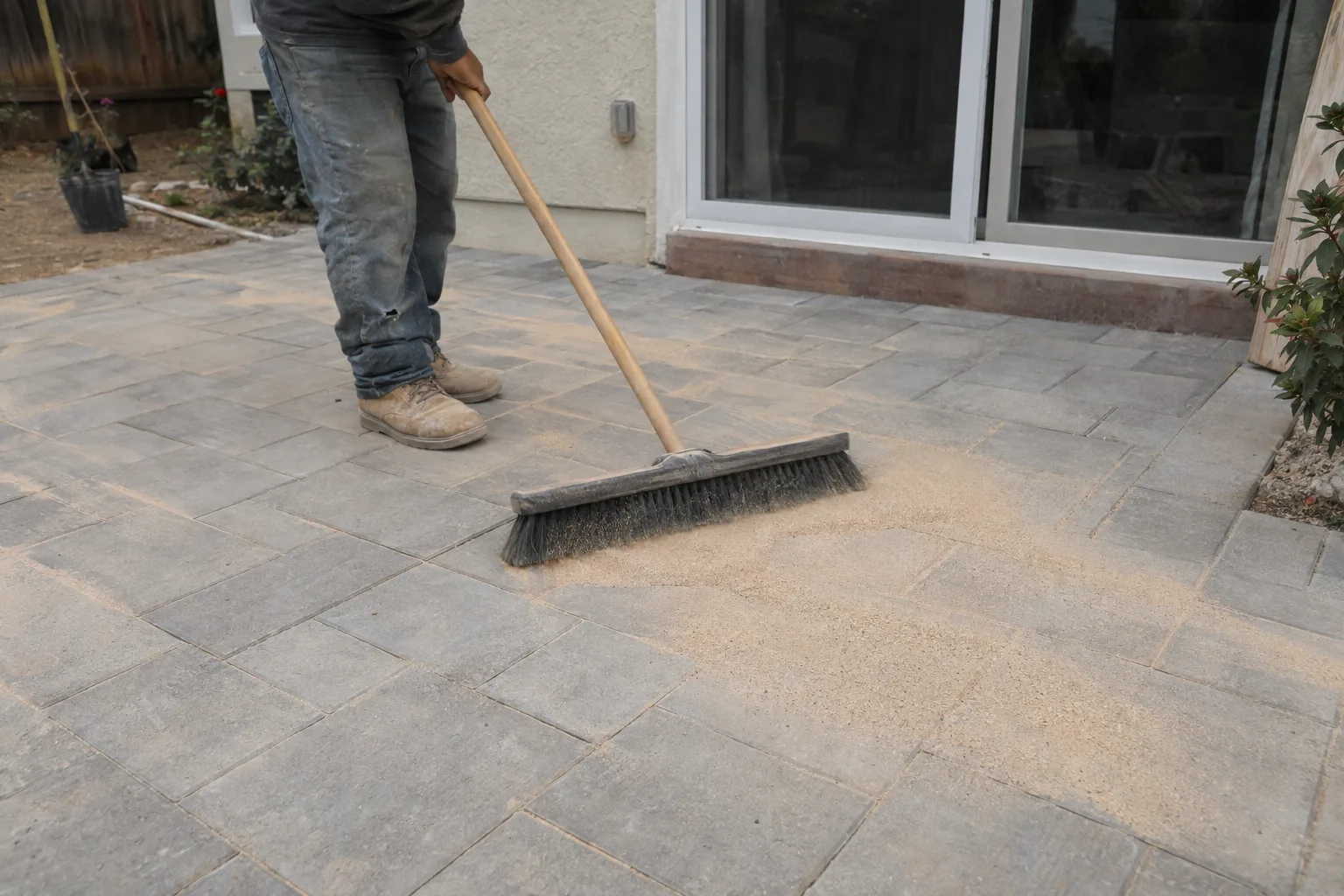
Each paver is set individually over a compacted base - so the pattern stays where you put it.
What Concrete Pavers Actually Deliver on a Los Angeles Property
Concrete pavers give you a durable, designed surface that holds up under both traffic and time.
Unlike a single slab, a paver surface moves as individual units. That matters here. Los Angeles soil - particularly in hillside neighborhoods and older flatland lots - expands and contracts with seasonal moisture shifts. A flexible paver layout handles that movement better than a rigid slab that cracks under pressure.
The result is a surface that looks intentional and stays that way.
Why LA Homeowners Choose Pavers for Driveways, Patios, and Walkways
Pavers work especially well in Los Angeles because the surface tolerates the region's thermal cycling.
Thermal cycling - the repeated expansion and contraction caused by temperature swings - affects every outdoor surface in Southern California. Summer ground temperatures push high, especially on west-facing driveways and sun-exposed patios. Overnight dips in winter shift moisture levels in the soil beneath.
Concrete pavers handle this well. Individual units flex slightly with the ground. If one unit does shift, it can be reset without rebuilding the entire surface.
Here's what many homeowners discover about paver driveways in Los Angeles: the pattern choice affects more than looks. Herringbone and interlocking patterns distribute vehicle load across more contact points. That's relevant on steeper driveways throughout the Hollywood Hills and Silver Lake areas, where vehicle weight concentrates differently on a slope.
We install concrete pavers for driveways, patios, and walkways across Los Angeles. Every surface type gets base work matched to its load requirements.
A Call We Often Get About Pavers That Shifted After the First Summer
The most common paver concern we hear involves units that moved within the first season.
I'm Liam Harris, founder of SNA Remodeling Hollywood. A call we often get goes something like this: a homeowner had a paver surface put in, it looked great at first, and then by August several units had rocked or lifted at the edges.
The pattern is almost always the same. The visual side of the job - the paver selection, the layout design - was handled carefully. The base beneath it wasn't.
In Los Angeles, the sub-base - the compacted gravel layer beneath the sand bed and pavers - has to be graded for drainage and compacted to handle load. On driveways, that load includes the full weight of a vehicle over the same path every day. On a patio or walkway, foot traffic concentrates in predictable spots - near entry points, along the edges, at corners.
When drainage grading - the process of shaping the base layer so water moves away from the surface - is skipped or done poorly, moisture pools under the sand bed. Saturated sand shifts. Pavers follow it.
The fix isn't complicated. But it takes the right base preparation from the start. That's the work we focus on before a single paver goes down.
How a Properly Prepared Base Keeps Every Unit in Position
A compacted sub-base is what keeps concrete pavers level and locked in over the long term.
Sub-base compaction - the process of pressing the gravel base layer until it reaches a stable, load-bearing density - is what separates a paver surface that lasts from one that needs early repairs.
After compaction, a sand bed is screeded level. Each paver unit is then set individually into that bed. Edge restraints - the borders that hold the outer perimeter of the layout - are secured to prevent lateral drift.
This isn't a fast process. But it's the one that keeps the pattern you chose at the start intact five years later. We grade for drainage before we compact. We compact before we screed. We screed before we set. The sequence isn't optional - it's what the result depends on.
How We Select, Grade, and Set Concrete Pavers From Start to Finish
Every paver project at SNA Remodeling Hollywood follows the same base preparation standard, regardless of size.
Our process covers the full scope of paver installation - from material selection through final surface check. Here's what that looks like:
- Material selection:Concrete paver units come in different thicknesses. Driveway applications require thicker units than walkways. We match the paver spec to the surface load.
- Pattern selection:Herringbone, running bond, basketweave - each pattern has different structural properties. We walk through the options before any base work starts.
- Drainage grading:The base layer is shaped to direct water away from the surface. We set the slope before compaction.
- Sub-base compaction:Mechanically compacted to load-bearing density. No shortcuts on this step.
- Sand bed screeding:A consistent sand layer sets the level for each unit.
- Individual paver placement:Each unit is hand-set and checked for level and spacing.
- Edge restraint installation:Perimeter borders lock the layout in place and prevent drift.
- Joint sand sweep:Sand is swept into the joints and compacted to prevent unit movement.
Every step in sequence. The base work carries the surface.
From Base Compaction to Final Pattern - Our Installation Sequence
Our installation follows a fixed sequence - base first, surface second, finish last.
Site Assessment
Before base work begins, we assess the existing ground. Soft spots, poor drainage paths, and grading issues are identified and addressed. On driveways, we check for any existing slab material that needs removal. On patios and walkways, we confirm the layout dimensions and pattern orientation with the homeowner before excavation starts.
Installation
Excavation goes to the depth required for the sub-base, sand bed, and paver thickness combined. The sub-base is spread, graded for drainage, and compacted in layers. Sand is screeded level across the full surface. Pavers are placed individually, pattern by pattern, from one corner to the opposite edge. Edge restraints are set and secured.
Surface Verification
Before the project is complete, we walk the finished surface. Each unit is checked for level. Joint sand is swept in and compacted. Edge restraints are inspected for stability. The drainage slope is confirmed to direct water away from any structure. The homeowner sees the finished layout before we leave.
Concrete Paver Installation Across Los Angeles and Surrounding Neighborhoods
SNA Remodeling Hollywood installs concrete pavers throughout Greater Los Angeles.
We serve homeowners in Los Angeles, West Hollywood, Hollywood, Silver Lake, Culver City, Beverly Hills, Burbank, Santa Monica, Studio City, Sherman Oaks, Pasadena, Glendale, and beyond. Our crews are based on Martel Avenue in Los Angeles - centrally located for access to projects across the basin and into the Valley.
Explore our paver installation services and hardscape design and installation pages for related options.
Ready to Plan Your Paver Surface? Here's How to Get Started
Contact SNA Remodeling Hollywood to discuss your concrete paver project in Los Angeles.
Call us at +1 323-761-0179 or email info@snaremodeling.com. Tell us where the surface is going - driveway, patio, or walkway - and we'll take it from there. You can also reach us through our website to describe your layout idea and timeline.