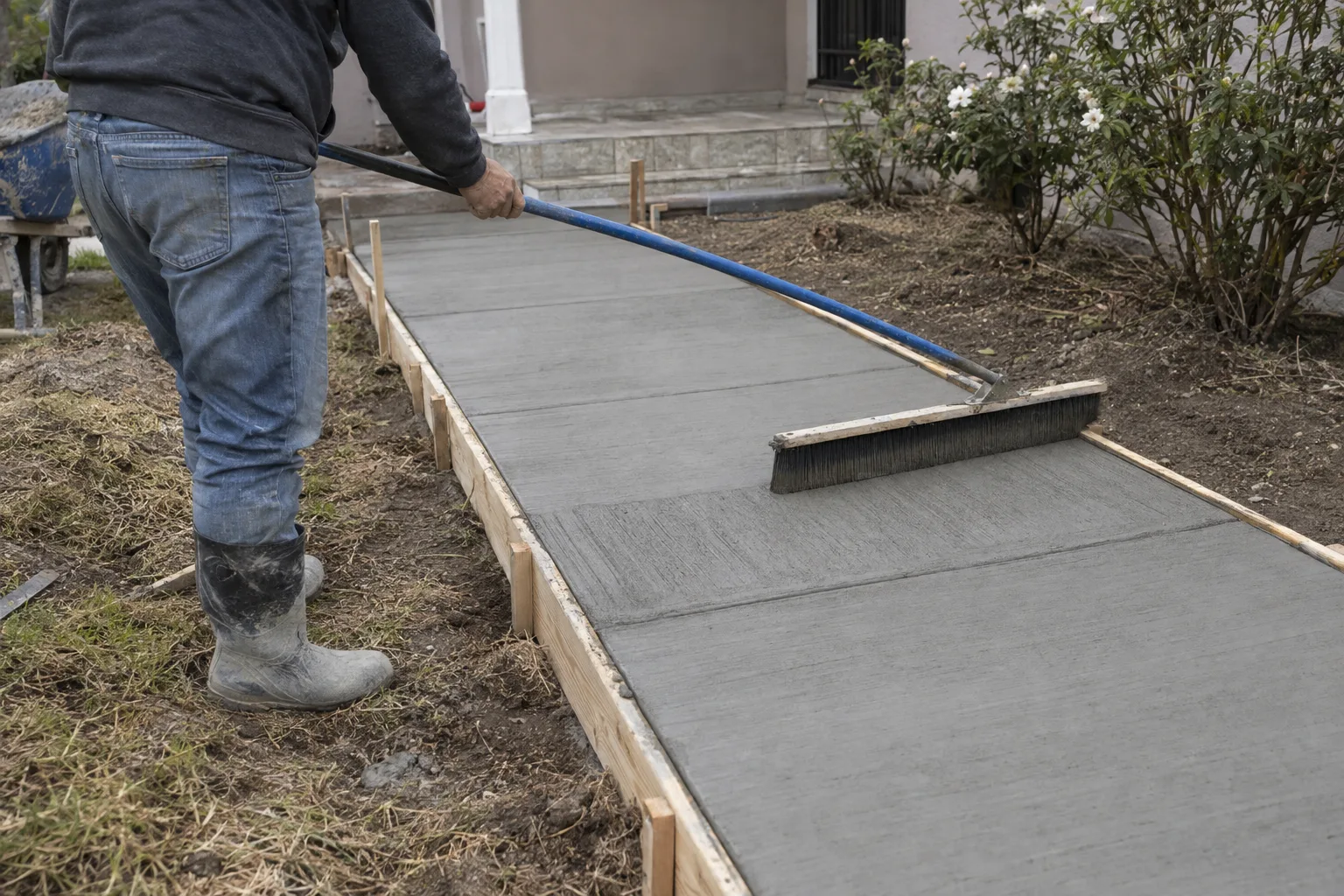
Formed, graded, and finished by an in-house crew serving Los Angeles.
What Goes Into a Concrete Walkway That Actually Holds
A concrete walkway is only as good as the prep work underneath it.
A proper walkway starts with soil compaction: packing down the base layer so the slab doesn't settle unevenly once the weight of cured concrete is on top of it. Then the forms go in, set to the correct grade. Finish grading - sloping the surface so water drains away from the house rather than toward it - is not a cosmetic choice. It determines whether rainwater moves off your path or channels toward your foundation.
Control joints come next. These are planned cuts in the slab that guide where the concrete flexes as temperatures change. Without them, the slab cracks wherever it wants to. With them, the movement happens at predictable lines.
Surface texture - broom finish, smooth, or exposed aggregate - is chosen last. It affects both how the path looks and how much traction it offers underfoot.
That's the full picture of what goes into a walkway that actually performs over time.
Walkways Across Los Angeles Neighborhoods We Know Well
LA's older neighborhoods have some of the most layered walkway situations in the region.
Our office is at 1433 N Martel Ave in Los Angeles - a few blocks from Runyon Canyon and the older residential grid that runs through Hollywood and West Hollywood. From that base, our crew works across the neighborhoods within reach: Silver Lake, Culver City, Studio City, Sherman Oaks, and farther out across the San Fernando Valley and into the South Bay.
These are neighborhoods built out in the 1940s through 1960s. Many properties still have their original concrete paths. Those paths have been working for sixty or seventy years - under pressure from established street trees, through decades of wet and dry cycles, and across soil that has shifted and settled repeatedly.
Here's what most homeowners don't realize about older LA walkway work: the tree root situation matters more than the concrete condition. A path that looks flat may already be undercut by roots. That base assessment shapes the whole approach before any forming begins.
We bring that same grading and forming discipline to backyard concrete walkway projects, side-yard passages, and front entry approaches across Los Angeles.
A Situation We See Often on Older LA Properties
From Liam Harris, Founder & CEO, SNA Remodeling Hollywood:
A call we often get goes something like this. A homeowner in Hollywood or Silver Lake has a front walkway that's been fine for years. Then one winter - and LA's rainy seasons can deliver concentrated bursts, not gradual soaking - they notice a lip where two sections of the path have shifted. One section pushed up, one stayed flat.
I'll walk the property and find tree root displacement at work. The roots of a mature street tree - ficus and ash are common along older LA blocks - have pushed under the slab. One section heaved. The other stayed put. Now there's an inch or more of height difference between two adjacent slabs.
What makes this interesting from a forming standpoint is that you can't just pour over what's there. You have to remove the affected section, cut back or bridge the root issue, recompact the base, and then form and pour to the correct finish grade. The new section has to match the adjacent grade, not just sit flat. Flat isn't always level when your site has any slope at all.
The front approach matters more than people give it credit for. It's what visitors walk every time they arrive. Getting the grade right on a front walkway means water moves off it cleanly and the two panels on either side of a control joint stay within a quarter inch of each other long-term. That's the standard we hold this work to.
Grading Is Decided Before the First Form Goes In
Every walkway we build is graded from the first layout decision - not adjusted after the pour.
Here's how we handle it. Before the forms go in, we establish the correct pitch for the path based on where the walkway starts, where it ends, and what sits alongside it. That means calculating how much the surface needs to slope - typically a minimum of two percent away from any structure - so water runs off rather than pools or redirects.
This decision happens at layout, with a level and a grade stake. It gets locked in when the forms are set. By the time concrete goes in, the grading outcome is already determined by the form position - not by how the finisher works the surface.
The result is a path that moves water the right direction. Every time it rains. Whether that's a light December drizzle or one of those January storms that drops two inches in a few hours across greater Los Angeles.
How We Form, Pour, and Finish Every Walkway
Consistent methods on every job, regardless of walkway size or location.
- Base preparation:Sub-grade is checked, graded, and compacted before forming begins
- Form setting:Wood or metal forms establish the width, edge, and slope - set to the planned finish grade
- Concrete mix:Mix spec is matched to the project's exposure conditions and load requirements
- Reinforcement:Wire mesh or rebar placed per project requirements before the pour
- Control joints:Cut or tooled at planned intervals to manage slab movement
- Surface finish:Broom finish applied for standard residential walkways; texture options discussed per project
- Curing:Concrete curing is protected and not rushed - the process by which poured concrete hardens and reaches full strength over several days
- Edge cleanup:Forms removed cleanly, edges finished, site left in order
Three visits are standard on most walkway jobs: prep and forming, pour and finish, form removal and inspection. Not compressed into one day unless the site and scope allow for it.
From Site Prep to Final Cure - the Full Sequence
The process runs in a fixed order. Each step depends on the one before it.
Diagnostics
We start by walking the site. We check the existing grade, look for tree root intrusion, and assess what the base layer is working with. If there's an existing slab being replaced, we note the condition of the edges and any drainage patterns that need to be corrected. Side yard paths get checked for clearance and drainage direction. Front walkways get measured for pitch toward or away from the structure.
Implementation
Forms go in first. They set the shape, width, and grade of the finished slab. Base material is compacted. Reinforcement is placed. The concrete pour follows - mixed to spec, placed in the forms, and worked to the correct surface texture. Control joints are cut or tooled before the surface sets. Edges are finished while the concrete is still workable.
Post-Service Review
Forms come off after the concrete has set sufficiently - usually the following day. We check the edge quality, surface texture consistency, and confirm the finished grade matches the plan. Water should move cleanly across the surface and away from adjacent structures. We look for any surface issue while there's still time to address it during the concrete curing period. The slab reaches full strength over several days. We document what was done and the condition of the finished work.
Where We Work in Greater Los Angeles
SNA Remodeling Hollywood serves a wide reach across Los Angeles and surrounding areas.
We complete concrete walkway installation and replacement projects across Los Angeles, West Hollywood, Hollywood, Silver Lake, Culver City, Beverly Hills, Burbank, Glendale, Studio City, Sherman Oaks, Van Nuys, Encino, Santa Monica, Pasadena, Long Beach, Torrance, Inglewood, and communities throughout the San Fernando Valley and Greater LA region.
Ready to Plan Your Walkway? Here's How to Start
Reach out with the basics - location, approximate size, and what you're working with.
Call us at +1 323-761-0179 or email info@snaremodeling.com. Describe where the walkway goes: front entry, side yard, backyard, or a connection between two areas. We'll ask a few follow-up questions and arrange a site visit. From there, the scope and sequence get sorted out in person - not over the phone.