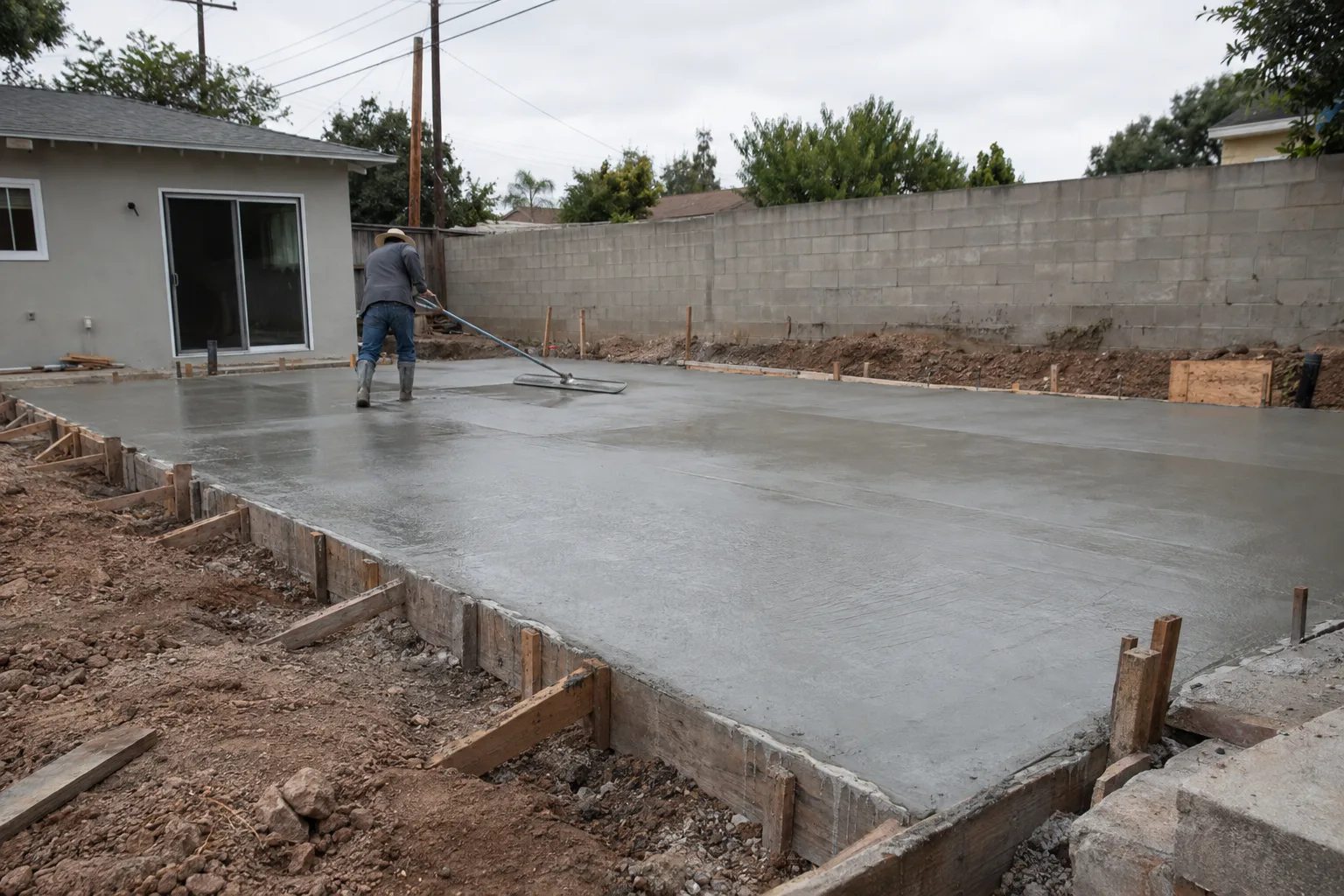
Your slab, driveway, or walkway installed by one in-house crew, start to finish.
What Sound Concrete Work Actually Requires in Los Angeles
Good concrete work in Los Angeles starts well below the finished surface.
Los Angeles sits across multiple soil types. Some neighborhoods carry clay-heavy ground that swells when wet and shrinks in dry heat. Others sit on fill soil or on slopes that add lateral pressure to any slab or surface. Poured on an unprepared base, concrete doesn't last. It cracks. Water gets in. The ground moves again.
Getting concrete work right means placing it on a properly graded, compacted base - with a mix design (the ratio of cement, aggregate, and water) matched to what the surface will carry.
How LA's Soil and Seismic Conditions Shape Every Pour
Every concrete pour in Los Angeles happens inside a seismic zone - and that changes how we work.
A seismic zone is a designated area with elevated earthquake risk. It affects how structural concrete is specified, how rebar is placed, and what thickness a slab needs to handle lateral movement. Los Angeles isn't one geological environment - it's dozens.
Concrete construction in the Hollywood Hills means working on steep, rocky terrain with drainage running downhill. Out in Sherman Oaks or Van Nuys, the San Fernando Valley's alluvial soil compacts differently than the clay pockets found around Culver City or Inglewood. Near the west side, properties closer to the Santa Monica Mountains sit in micro-zones where slope and proximity to old fill zones both affect slab performance.
SNA Remodeling Hollywood's crews are active across the LA basin. We've placed concrete on hillside setbacks, tight urban lots, and flat multi-family properties - each with a different base preparation strategy.
A Call We Often Get: The Slab That Started With a Hairline Crack
Concrete that cracks early almost always has the same story - base prep was skipped or rushed.
I'm Liam Harris, founder of SNA Remodeling Hollywood. Here's a call we take regularly.
A homeowner notices a thin line running across their driveway or patio slab. It looks cosmetic. They leave it. By the next wet season, water has worked its way in. The line gets wider. Then a section lifts slightly - just enough to catch a foot or scrape a car bumper.
When we look at these situations, the pattern is usually the same. The concrete slab - a poured flat surface used as a structural base or finished ground-level surface - was placed over soil that wasn't properly compacted. Or the control joints, the planned cuts that guide cracking to protect the slab, weren't cut deep enough or placed correctly. Or the mix design wasn't matched to outdoor residential use.
What's worth understanding about Los Angeles specifically is that the dry-wet-dry cycle here accelerates this process. A hairline crack that might stay stable for a decade in a more temperate climate can open significantly in two to three LA winters. The crack isn't the problem. It's the indicator of what was missed below.
When our crew takes over concrete construction on a new residential project, we treat base preparation as the job - not the thing you do before the real job. Compaction - the process of densifying soil beneath a slab to prevent settling - is checked, not assumed. Forms are set to final grade before anything is ordered. The mix arrives right. The pour is monitored. And curing time - the period after placement during which concrete reaches full design strength - is respected, not cut short.
That sequence is why the finished surface holds.
One Crew Handles Every Stage - From Base Prep to Final Finish
From excavation to final finish, the same SNA crew handles your entire concrete project.
Concrete work depends on continuity. When one team grades the base and a separate crew sets forms, nobody owns the full picture.
SNA Remodeling Hollywood runs one in-house crew across every stage of concrete installation: site prep, grading, formwork, pour, and finishing. The crew that compacts your base is the crew that places your concrete and checks the surface before walking off the job.
That structure matters for residential concrete construction Los Angeles properties rely on - because it means accountability runs all the way through the project.
How We Set Forms, Grade the Base, and Control the Pour
Concrete work done right follows a non-negotiable sequence - every time.
Our standards on every concrete project:
- Base preparation first.Excavate to depth, remove organic material, compact the subgrade.
- Formwork set to grade.All formwork is leveled and secured before any concrete is ordered.
- Mix design matched to the application.A residential walkway and a structural ADU slab get different specs.
- Rebar or wire mesh placed before the pour.Never added after.
- Control joints placed at correct intervals.Deep enough to actually guide cracking where intended.
- Surface finish appropriate to use.Brushed for traction, smooth for covered areas, exposed aggregate where specified.
- Curing respected.No traffic, no load until the concrete reaches working strength.
This applies to concrete driveways, walkways, hardscape bases, and outdoor concrete installation across residential and multi-family properties in Los Angeles.
What Happens on Your Property Between Day One and Project Completion
Every concrete project runs through three clear phases - and you know what's happening at each one.
Site Walk and Scope Review
We walk the site first. Slope, soil type, existing drainage, setbacks, and tie-ins to adjacent structures all get noted. For foundation-adjacent concrete work or slabs tied to an ADU build or room addition, we coordinate the scope before setting a single form.
Excavation, Forming, and Pour
Excavation comes first. We dig to the correct depth for the slab type - deeper for structural work, standard residential depth for driveways and walkways. Soil is compacted in lifts. Forms go in, leveled to finished grade. Steel reinforcement is placed. Concrete is poured, consolidated, and finished to the specified surface texture. Control joints are cut before the slab locks up.
For larger pours - multi-family lots, wide driveways, structural slabs - we stage the work to keep each section manageable and minimize shrinkage cracking.
Surface Inspection and Project Handoff
We check the finished surface before leaving. Edge definition, joint depth, surface texture, and drainage slope all get verified. If concrete work ties into hardscape design and installation, pavers, or a retaining wall, we coordinate the sequence so each element ties in cleanly.
Concrete Construction Across Los Angeles and the Surrounding Region
SNA Remodeling Hollywood serves concrete projects across Greater Los Angeles.
We work in Los Angeles, West Hollywood, Hollywood, Silver Lake, Culver City, Beverly Hills, Burbank, Glendale, Santa Monica, Inglewood, Studio City, Sherman Oaks, Van Nuys, Pasadena, Torrance, Long Beach, and throughout the San Fernando Valley. Our crews also serve Ventura County and the Inland Empire - including Thousand Oaks, Ontario, and Rancho Cucamonga.
Ready to Talk Through Your Concrete Project?
If you have a slab, driveway, walkway, or hardscape base to build, we're ready to look at it.
Tell us your property location, what you need poured, and when you're looking to start. SNA Remodeling Hollywood handles concrete installation in Los Angeles from initial site review through finished surface - one crew, no handoffs.
Call us at +1 323-761-0179 or email info@snaremodeling.com to get the conversation started.